Start a Feminine Intimate Care Brand: 6-Step OEM Guide
How to start a feminine intimate care brand in six steps - from defining your market and product line to selecting an OEM partner - with real MOQ, sample and lead-time data from a certified manufacturer.
For B2B buyers and brand founders: this guide walks through the exact six steps that turn a feminine intimate care idea into a sellable product, with the standards a qualified OEM partner should meet at every stage.
Who this guide is for: brand founders, procurement managers, distributors, and DTC sellers evaluating feminine intimate care OEM/ODM manufacturing.
Introduction: From Idea to Launch in Six Steps
The global feminine hygiene market was valued at approximately USD 33.9 billion in 2025 and is projected to nearly double by 2034, according to market research firm Straits Research. Within this market, cleaning and deodorizing products - including pH-balanced intimate washes - are among the fastest-growing segments, with an estimated CAGR of about 8.7%.
Yet many brands never launch. Not because of a lack of ideas, but because they don’t know how to turn an idea into a real product - how to choose a product line, what MOQ to expect, and who to trust with formulation and production.
This guide shows you how, step by step. It is written by Zhongkang Bainian, a China-based OEM/ODM manufacturer with 37+ years of factory heritage, 27+ years of OEM/ODM expertise, and a self-owned 20,000 m² garden-style industrial park. The process below is the one we run with our own brand partners every day - so you can follow it with any qualified supplier.
Step 1: Define Your Target Market
Before developing a single product, define who you are selling to. This determines your formulation, ingredients, packaging language, and the registration route you will need.
- Which country or region will you launch in first - Southeast Asia, North America, Europe, or the Middle East?
- Online or offline first - a DTC store, pharmacy channel, or both?
- Premium, mass-market, or value positioning?
Different markets carry different registration requirements - for example BPOM in Indonesia, NPRA in Malaysia, the Philippine FDA, and the ASEAN Cosmetic Directive across the region. The right OEM should help you plan for these from day one.
Buyer action: write a one-page brief stating region, channel, price band, and the target consumer’s main concern. Bring it to every OEM conversation - it determines formula direction and registration scope.
Common mistake: launching “everywhere at once”. Brands that focus on two or three markets in their first year test faster and spend their registration budget where it counts.
Step 2: Choose the Right Product Line
Most successful brands start with one to three core products instead of a full range. Starting narrow lets you validate demand, manage inventory, and build a focused story before expanding.
| Product Format | Typical Use | Why It Sells |
|---|---|---|
| pH-balanced feminine intimate wash | Daily gentle cleansing | Fastest-growing segment; low barrier to entry |
| Probiotic or botanical vaginal gel | Comfort and moisture support | High repeat purchase; premium margins |
| Intimate tightening softgels | Targeted wellness | Strong differentiated positioning |
| Intimate massage serum | Spa and postpartum care | Premium positioning, strong margin |
| Antibacterial personal spray | On-the-go hygiene | Convenience format for travel and daily use |
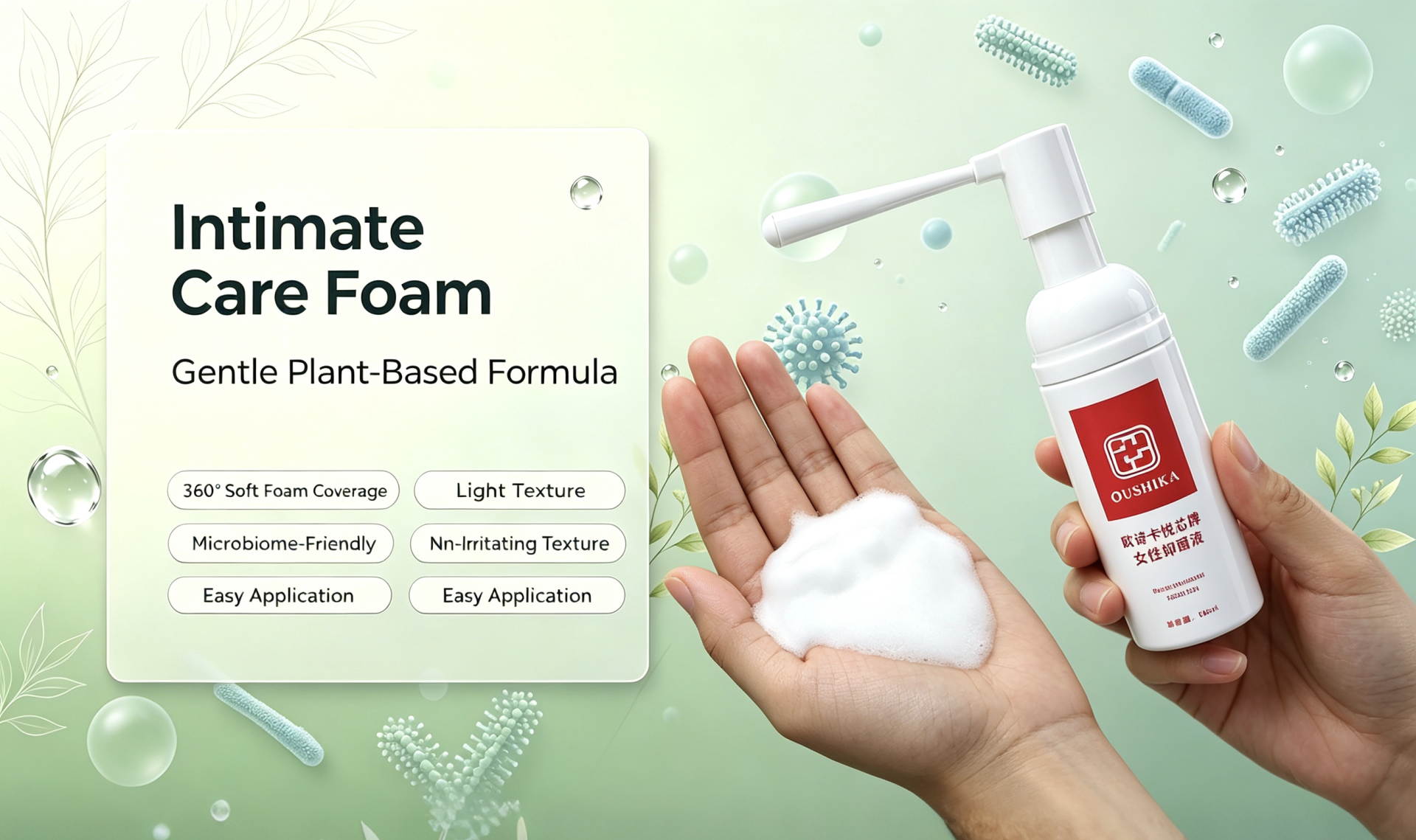
Start with formats that match your brand promise and your target market’s registration appetite. See our full product range for the formats we manufacture.
Buyer action: choose 1-3 formats and get feedback from your OEM’s formulation team before freezing the line-up. They can flag registration, stability, or supply issues early, when changes are cheap.
Common mistake: copying a competitor’s entire catalog. A narrow, well-executed launch line outperforms a broad but shallow range.
Step 3: Decide Between Custom Formulation or Private Label
There are two main routes to market, and a middle one most brands actually use.
| Route | Cost and Time | Risk | Best For |
|---|---|---|---|
| Fully custom formulation | Highest cost; 3-6+ months | Higher | Established brands with a unique claim |
| Semi-custom (proven base + tailored actives) | Medium | Moderate | Brands that need differentiation without starting from zero |
| Private label (proven base) | Lowest cost, fastest | Lower | New brands, market testing, first SKUs |
For most new brands, starting with proven, tested base formulations is the best strategy: it reduces development time, controls cost, and lets you test the market quickly. As your brand grows and you validate demand, you can shift toward semi-custom or fully custom development with a proprietary formula. Explore our private label program.
Buyer action: ask your OEM which base formulations carry the strongest safety data - especially mucosal testing - and start there.
Common mistake: paying for full custom development before validating demand. You can lock a proprietary claim later; you cannot easily recover a burned launch budget.
Step 4: Understand the OEM Process
A typical feminine intimate care OEM project follows five stages:
- Product selection or formulation confirmation - you pick a base formula or brief a custom one.
- Sample development - about 7 days at our factory, with feedback rounds.
- Packaging design and approval - bottles, tubes, cartons, labels.
- Mass production - lead time 30-60 business days depending on format and quantity.
- Quality control and shipping - batch QC, COA per batch, export documentation.
The manufacturing environment matters as much as the formula. Feminine intimate care products should be produced in a GMP-managed clean workshop with hygiene controls in place throughout compounding, filling, and packing - not in a standard cosmetic workshop.
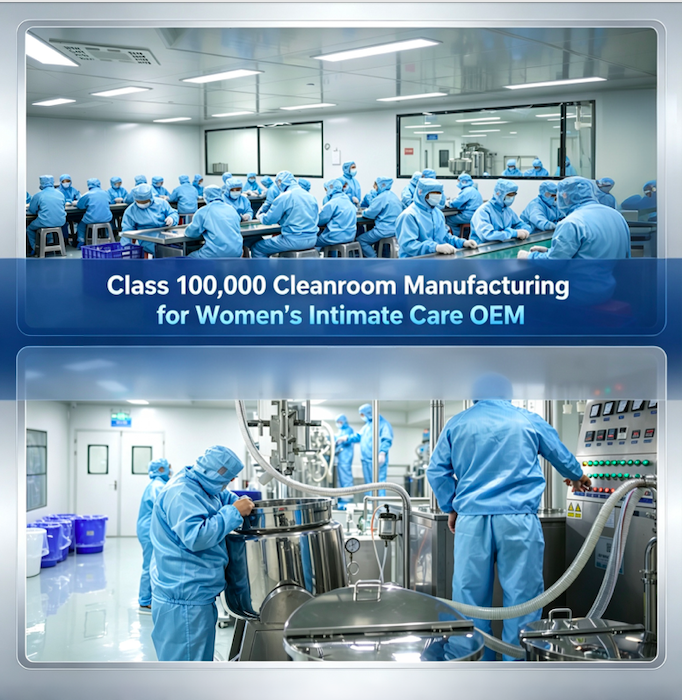
Buyer action: before signing, ask your OEM for their standard project timeline in writing, including the sample-development schedule and the production lead time for your format.
Common mistake: treating sample approval as the end of development. Packaging validation, batch stability, and registration dossiers all come after - budget time for them. For the full stage-by-stage detail, read our OEM project process guide.
Step 5: Know the MOQ and Timeline
For most private label and semi-custom projects, here is what to expect:
| Stage | Typical Value |
|---|---|
| Minimum order quantity (MOQ) | 1,000-5,000 pcs depending on packaging and format |
| Sample development | About 7 days |
| Mass production lead time | 30-60 business days |
| Shelf-life stability data | Up to 2 years, batch-assayed |
Numbers vary by product format and packaging - bottles and tubes differ from printed cartons and softgel blisters. Always ask for format-specific MOQ rather than a single blanket figure.
Buyer action: match your first order to a realistic sell-through plan. An MOQ you can sell in three to four months is more valuable than a larger one that sits in a warehouse.
Common mistake: ordering maximum volume to “save on unit cost” before validating demand. Inventory risk is the most common startup killer in this category.
Step 6: Choose the Right Manufacturer (The Most Important Step)
Choosing the wrong supplier can lead to unstable products, quality issues, delays, and hidden costs. A reliable feminine intimate care manufacturer should offer:
- GMP-certified production - ISO 22716 and/or GMPC, ideally verified by a third party such as SGS, with a clean workshop.
- Stable, tested base formulations - with mucosal safety data, not just skin testing.
- In-house quality control - COA per batch, MSDS, stability data, and batch traceability.
- Export documentation and registration support - for BPOM, NPRA, FDA, and ASEAN market entry.
- OEM and private label experience - with brands selling in your target market.
| Supplier Checklist | Why It Matters | What to Ask |
|---|---|---|
| GMP certification | Proves controlled production | Request the certificate and the certificate holder |
| Clean workshop | Reduces contamination risk | Ask for the workshop class (e.g., 100K / ISO 8) |
| Mucosal safety testing | Verifies suitability for intimate use | Request CMA-accredited test reports |
| Export documentation | Required for registration | Ask for COA, MSDS, and stability samples |
| Batch traceability | Accountability across the supply chain | Ask how batches are traced to raw materials |
At Zhongkang Bainian, our facility is SGS-certified to ISO 22716 and GMPC and operates a 100K-class (ISO 8) clean production workshop. We also hold ISO 9001, ISO 14001, and ISO 45001 certifications. Our dual licenses - the Cosmetic Production License (Min-Zhuang 20220008) and the Disinfectant Manufacturer Hygiene License ((Min) Wei-Xiao-Zheng-Zi (2021) No.040036) - let us serve both cosmetic and disinfectant-registered product lines. View our certifications and test reports.
Buyer action: shortlist three to five factories, request the certificates and test reports above, and compare their standard MOQ, sample time, and lead time before you engage.
Common mistake: choosing on unit price alone. The cheapest quote without GMP, testing data, and documentation will cost far more later in rework and registration delays.
Frequently Asked Questions
Q1: How long does it take to start a private label feminine intimate care brand?
With a private label or semi-custom route, a typical project runs 30-60 business days from order to mass production, plus about 7 days for sample development. A full custom formulation takes longer because the formula, packaging, and stability data are built from scratch.
Q2: What is the minimum order quantity for private label feminine intimate care products?
MOQ typically ranges from 1,000 to 5,000 pieces depending on product format and packaging. Bottles and tubes usually have lower MOQs, while printed cartons, softgel blisters, and custom tooling raise the minimum.
Q3: Custom formulation or private label - which should a new brand choose?
For most new brands, a proven private label or semi-custom base is the best starting point: it reduces development time, controls cost, and lets you test the market quickly. Fully custom development makes sense once demand is validated and you need a proprietary claim.
Q4: What certifications should a feminine intimate care OEM manufacturer have?
Look for GMP certification such as ISO 22716 or GMPC, ideally third-party verified (for example by SGS), plus ISO 9001, ISO 14001, and ISO 45001. For product registration, the manufacturer should also provide COA, MSDS, stability data, and CMA-accredited test reports including mucosal safety.
Q5: What documents should an OEM supplier provide for export markets?
A qualified manufacturer should provide COA per batch, MSDS, stability test reports, and CMA-accredited test reports including mucosal safety. For export markets, additional technical dossier support may be required for BPOM, NPRA, FDA, and ASEAN market entry.
Q6: Is mucosal safety testing really necessary for intimate care products?
Yes. Dermatological testing confirms tolerance on skin, but the intimate area is mucosal tissue, which is significantly more sensitive. A product intended for intimate use should carry both skin and mucosal irritation test reports from a third-party accredited laboratory.
Sources
Market data and standards referenced in this guide:
- Straits Research - Feminine Hygiene Products Market Size, Share, Growth & Forecast by 2034 (2025). Global market valued at USD 33.88 billion in 2025, projected to USD 66.37 billion by 2034 (CAGR 7.78%); cleaning and deodorizing products CAGR 8.69%.
- ISO 22716:2007 - Cosmetics - Good Manufacturing Practices (GMP) - Guidelines on Good Manufacturing Practices. International Organization for Standardization.
- SGS - third-party inspection, verification, testing and certification of the ISO 22716 and GMPC quality systems referenced in this guide.
Launch Your Feminine Intimate Care Brand With Confidence
Tell us your idea, target market, or product concept - we’ll recommend the best formulation and OEM route for you.
*This guide is for informational purposes only. Market data and regulatory requirements vary by source and by market. Always consult with local regulatory experts before finalizing product specifications for your target markets.*