How to Choose a Supplier for Customized Functional-Enhanced Female Intimate Care Products (Private Area Care)
How to choose a supplier for customized private area care products - what functional enhancement means, the formulation and safety standards to verify, and the MOQ and documentation to request.
For B2B buyers and brand founders: this guide explains how to select a supplier for customized, functional-enhanced female private area care products - the ingredient standards, testing, MOQ, and documentation to verify before you commit.
Who this guide is for: brand founders, procurement managers, and distributors sourcing private area care lines - washes, gels, sprays, and targeted wellness products.
Introduction: Sourcing Customized Private Area Care That Performs
Private area care - products formulated specifically for the external intimate area - is one of the fastest-growing segments in personal care. Research firm Straits Research valued the global feminine hygiene market at about USD 33.9 billion in 2025 and projects it to nearly double by 2034, with cleaning and deodorizing products (including pH-balanced washes) among the fastest-growing categories.
Today’s buyers increasingly want more than a generic product. They want a customized, functional-enhanced line - a formula tuned to their market’s needs: a specific pH, gentle botanical actives, a unique scent direction, or a supported wellness claim. That is where choosing the right supplier matters most.
This guide is written by Zhongkang Bainian, a China-based OEM/ODM manufacturer with 37+ years of factory heritage, 27+ years of OEM/ODM expertise, and a self-owned 20,000 m² garden-style industrial park. It walks you through what private area care is, what functional enhancement really means, and how to choose a supplier that can deliver it.
What Is Private Area Care?
Private area care covers products designed for the external intimate area - washes, gels, sprays, moisturizers, and targeted wellness formats such as tightening softgels or massage serums. In markets across Southeast Asia and the Middle East, buyers often describe this category as “private area care”: a direct, consumer-facing term for intimate hygiene and comfort.
The core principle: the intimate area has a mildly acidic natural pH (around 3.8-4.5) and a delicate microbiome. Products must be formulated to support it, not disrupt it. This is the difference between a genuine private area care product and a body wash with a different label.
What Does “Functional Enhancement” Mean in Private Area Care?
Functional enhancement means adding a measurable benefit beyond basic cleansing - a purpose the product is designed to deliver. Here are the common enhancement directions a supplier should be able to execute:
| Enhancement Direction | What It Does | Example in a Formula |
|---|---|---|
| pH balancing | Keeps the formula in the mildly acidic range | Buffered wash held at pH 3.8-4.5 |
| Gentle cleansing | Non-soap surfactants that respect natural flora | Plant-based wash without SLS/SLES |
| Botanical soothing | Calming extracts for sensitive skin | Sophora flavescens, centella, chamomile |
| Microbiome support | Restores the microbial balance disrupted by harmful bacteria | Prebiotic fiber or lactic acid bacteria |
| Targeted wellness | Specific, supported benefits | Comfort, freshness, or tightening formats with antibacterial efficacy |
| Functional formats | Convenient delivery systems | Foam, spray, softgel, melt-away forms |
For a customized line, functional enhancement is where your brand differentiates. A supplier that can combine two or three enhancements in one formula - for example, a pH-balanced, microbiome-friendly wash with botanical soothing - gives you a product story competitors cannot copy. See the formats we manufacture across our product range.
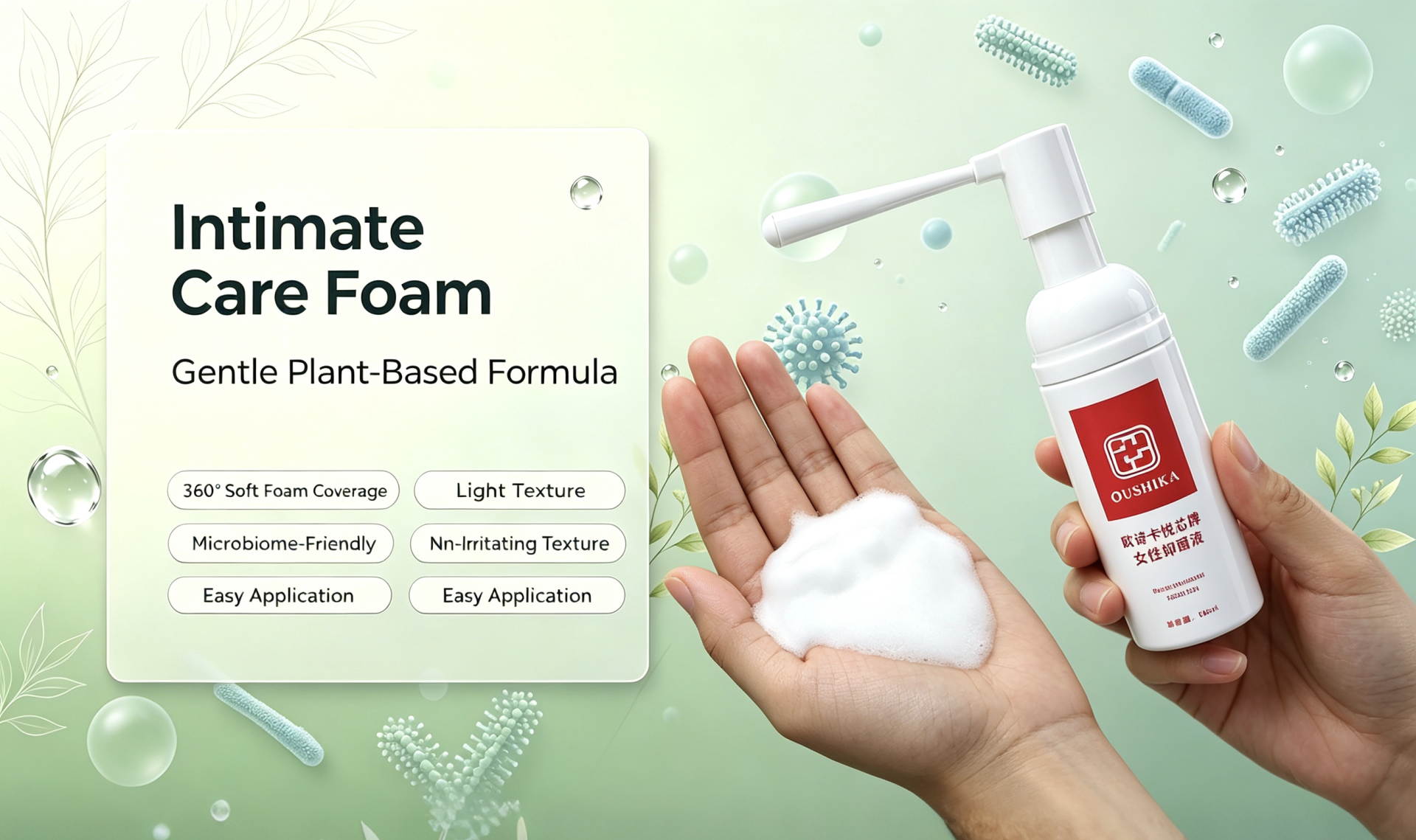
Buyer action: list the two or three enhancements your brand needs before approaching suppliers. A focused brief produces sharper quotes and faster samples.
Custom or Private Label? Two Routes to a Functional Line
To bring a functional-enhanced product to market, you have two main routes - and a middle option most brands actually use.
| Route | Time to Market | MOQ | Best For |
|---|---|---|---|
| Private label (proven base) | Fastest - sample in about 7 days | 1,000-5,000 pcs | Testing the market, first SKUs |
| Semi-custom (base + tailored actives) | Medium | 1,000-5,000 pcs | Adding a tailored active or scent |
| Fully custom formulation | 3-6+ months | Higher | Proprietary claims and unique positioning |
For most new brands, starting with a proven private label or semi-custom base is the fastest way to market: it reduces development time, controls cost, and lets you test the market quickly. Once demand is validated, you can customize one or two enhancements - an active, a scent direction, or a texture - to build a proprietary line. Explore our private label program.
Buyer action: confirm with your supplier that the chosen base formulation has full safety data (especially mucosal testing) before you invest in customization.
The OEM Process for Customized Products
A typical project follows five stages:
- Product brief and formulation confirmation - you brief the enhancements you want; the factory recommends a base.
- Formula and sample development - about 7 days at our factory, with feedback rounds.
- Packaging design and approval - bottles, tubes, cartons, and labels.
- Mass production - lead time 30-60 business days depending on format and quantity.
- Quality control and shipping - batch QC, COA per batch, export documentation.
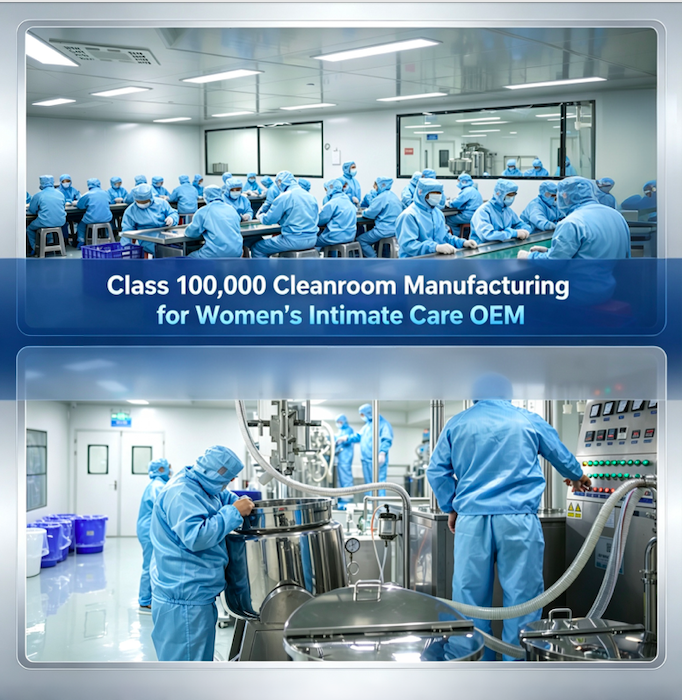
The manufacturing environment matters as much as the formula. Private area care products should be produced in a GMP-managed clean workshop with hygiene controls throughout compounding, filling, and packing - not in a standard cosmetic workshop.
Buyer action: ask your supplier for their standard project timeline in writing - including sample development and the production lead time for your specific format.
MOQ and Timeline at a Glance
| Stage | Typical Value |
|---|---|
| Minimum order quantity (MOQ) | 1,000-5,000 pcs depending on packaging and format |
| Sample development | About 7 days |
| Mass production lead time | 30-60 business days |
| Shelf-life stability data | Up to 2 years, batch-assayed |
Always ask for format-specific MOQ rather than a single blanket figure - a wash and a softgel do not share the same economics.
Buyer action: match your first order to a realistic sell-through plan. An MOQ you can sell in three to four months is more valuable than a larger order that sits in a warehouse.
How to Choose a Supplier: A 6-Point Checklist
Here is the checklist we recommend verifying with any candidate before you engage:
| Check | Why It Matters | What to Ask |
|---|---|---|
| 1. GMP certification | Proves controlled production | Request the ISO 22716 or GMPC certificate and the certificate holder |
| 2. Clean workshop | Reduces contamination risk | Ask for the workshop class (e.g., 100K / ISO 8) |
| 3. Mucosal safety testing | Verifies suitability for intimate use | Request CMA-accredited skin and mucosal test reports |
| 4. Functional formulation capability | Delivers the enhancement you briefed | Ask for their R&D team and past custom projects |
| 5. Export documentation | Required for registration | Ask for COA, MSDS, and stability samples |
| 6. OEM and private label experience | Familiarity with your target market | Ask which markets their brand partners sell into |
At Zhongkang Bainian, our facility is SGS-certified to ISO 22716 and GMPC and operates a 100K-class (ISO 8) clean production workshop. We also hold ISO 9001, ISO 14001, and ISO 45001 certifications, and our dual licenses - the Cosmetic Production License (Min-Zhuang 20220008) and the Disinfectant Manufacturer Hygiene License ((Min) Wei-Xiao-Zheng-Zi (2021) No.040036) - let us serve both cosmetic and disinfectant-registered lines. View our certifications and test reports.
Buyer action: shortlist three to five factories, request the certificates and test reports above, and compare their standard MOQ, sample time, and lead time before you engage.
Common mistake: choosing on unit price alone. The cheapest quote without GMP, testing data, and documentation will cost far more later in rework and registration delays.
Frequently Asked Questions
Q1: What is private area care?
Private area care covers products designed for the external intimate area - washes, gels, sprays, moisturizers, and targeted wellness formats such as tightening softgels or massage serums. It is the consumer-facing term many buyers in Southeast Asia and the Middle East use for intimate hygiene and comfort products.
Q2: What does functional enhancement mean in feminine intimate care products?
It means adding a measurable benefit beyond basic cleansing - pH balancing, gentle surfactants, botanical soothing, microbiome support, or targeted wellness claims. A customized line typically combines two or three enhancements, which is where a supplier’s formulation and R&D capability matters most.
Q3: What is the MOQ for customized private area care products?
MOQ typically ranges from 1,000 to 5,000 pieces depending on product format and packaging. Bottles and tubes usually have lower MOQs, while printed cartons, softgel blisters, and custom tooling raise the minimum.
Q4: How long does OEM production for private area care products take?
For most private label and semi-custom projects, sample development takes about 7 days and mass production runs 30-60 business days depending on format and quantity. Fully custom development takes longer.
Q5: What should I look for when choosing a private area care supplier?
Verify GMP certification (ISO 22716 and/or GMPC), a clean workshop, mucosal safety testing from an accredited laboratory, functional formulation capability, and complete export documentation (COA, MSDS, stability data). OEM and private label experience in your target market is a strong additional signal.
Q6: Is mucosal safety testing really necessary for private area care products?
Yes. Dermatological testing confirms tolerance on skin, but the intimate area is mucosal tissue, which is significantly more sensitive. A product intended for intimate use should carry both skin and mucosal irritation test reports from a third-party accredited laboratory.
Sources
Market data and standards referenced in this guide:
- Straits Research - Feminine Hygiene Products Market Size, Share, Growth & Forecast by 2034 (2025). Global market valued at USD 33.88 billion in 2025, projected to USD 66.37 billion by 2034 (CAGR 7.78%); cleaning and deodorizing products CAGR 8.69%.
- ISO 22716:2007 - Cosmetics - Good Manufacturing Practices (GMP) - Guidelines on Good Manufacturing Practices. International Organization for Standardization.
- SGS - third-party inspection, verification, testing and certification of the ISO 22716 and GMPC quality systems referenced in this guide.
Source Your Custom Private Area Care Line With Confidence
Tell us your concept, target market, or the functional enhancements you need - we’ll recommend the best formulation and OEM route for you.
*This guide is for informational purposes only. Market data and regulatory requirements vary by source and by market. Always consult with local regulatory experts before finalizing product specifications for your target markets.*