Perineal Care Market in 2026: Private-Label OEM Opportunities for Postpartum & Intimate Care Brands
Perineal care — gentle hygiene, soothing and freshness for the external perineal area — has long been treated as a clinical or hospital-channel category. In 2026 that is changing. Postpartum recovery is being re-framed as a continuous at-home self-care routine, everyday intimate-hygiene awareness is widening well beyond new mothers, and direct-to-consumer channels have made it possible for small private-label brands to reach audiences that traditional maternity retail never served well.
For brand owners reading the category today, the commercial logic is straightforward. Perineal care overlaps the mature postpartum and intimate-care segments without being identical to either — which means shelf space, search demand and retail listings are still being defined rather than locked down by incumbents. The technical side is less forgiving: delicate perineal tissue tolerates neither harsh body-care chemistry nor careless regulatory framing. That combination — an open category with a real formulation and compliance barrier — is exactly why a qualified private-label OEM/ODM partner, rather than a general cosmetics filler, belongs in the sourcing conversation early.
This article looks at what is driving the perineal care market in 2026, the product and regulatory decisions that separate a durable line from a disposable one, and how a brand owner should vet a contract manufacturer before signing an OEM or private-label project.
Why the Perineal Care Market Is Building Momentum in 2026
Demand for perineal care products is growing across four fronts that reinforce one another:
1. Postpartum recovery has moved out of the hospital room. Maternity guidance in North America and Europe increasingly frames the weeks after birth as a recovery period to be managed at home with dedicated products — not a handful of clinical disposables issued at discharge. Brands that package perineal spray, gentle wash or foam into coherent postpartum self-care kits are answering a need hospitals never productized.
2. Everyday perineal hygiene is normalizing for a wider audience. Beyond new mothers, adults managing sensitive external intimate skin, travel freshness, exercise-related care and general daily comfort are adopting perineal-hygiene habits. The user base is no longer defined by a single life stage.
3. DTC and marketplace channels accelerate category education. E-commerce lets niche postpartum and intimate-care brands teach a category, seed reviews and iterate SKUs without first negotiating for bricks-and-mortar shelf space. The result is faster category formation — followed, in time, by consolidation around manufacturers who can prove quality at scale.
4. Claims scrutiny raises the quality floor. Retailers, marketplaces and customs increasingly ask for the documentation behind a gentle, soothing or antibacterial positioning. Products whose claims outrun their test reports get delisted, which quietly removes the weakest competition and rewards manufacturers who can actually prove what they print.
Regional patterns are distinct. North America and Europe have the most mature consumer vocabulary around postpartum perineal care, with an established mommy-care retail ecosystem. Southeast Asia is the clearest emerging zone: specialist perineal products are still early, awareness is rising alongside spending on maternal and intimate wellness, and market entry runs through the region’s own notification and classification rules. Everywhere, the positioning that travels best is hygiene, comfort and freshness — the moment a product is framed as treating or healing a condition, it changes regulatory category and project risk.
Five Product Trends Defining Perineal Care in 2026
Trend 1: Postpartum Care Bundles Replace Single Clinical Items
Consumers now expect a postpartum kit to cover cleansing, soothing and everyday freshness rather than a single wipe or wash. Perineal spray, mild wash and foam formats are being bundled into curated sets for at-home recovery. For a private-label brand this shifts the opportunity from one SKU to a coherent recovery line — a formulation-and-packaging program, not a one-off fill.
Trend 2: Gentle, Alcohol-Free Formulation Is the New Premium Baseline
The generic approach — heavy fragrance, high alcohol loading, an unbalanced pH — no longer passes in perineal care aimed at postpartum and sensitive-skin users. Leading products are alcohol-free, pH-conscious and botanical-led, engineered for sensitive external tissue rather than borrowed from body care. Where genuine antibacterial performance is required, credible partners verify it in a laboratory instead of asserting it on a label: our alcohol-free intimate spray line, for example, documents a >97% bacteriostatic rate tested under laboratory conditions — a claim bounded to the test, not promoted as a treatment.
Trend 3: Format Diversification — Perineal Spray Leads Alongside Wash and Foam
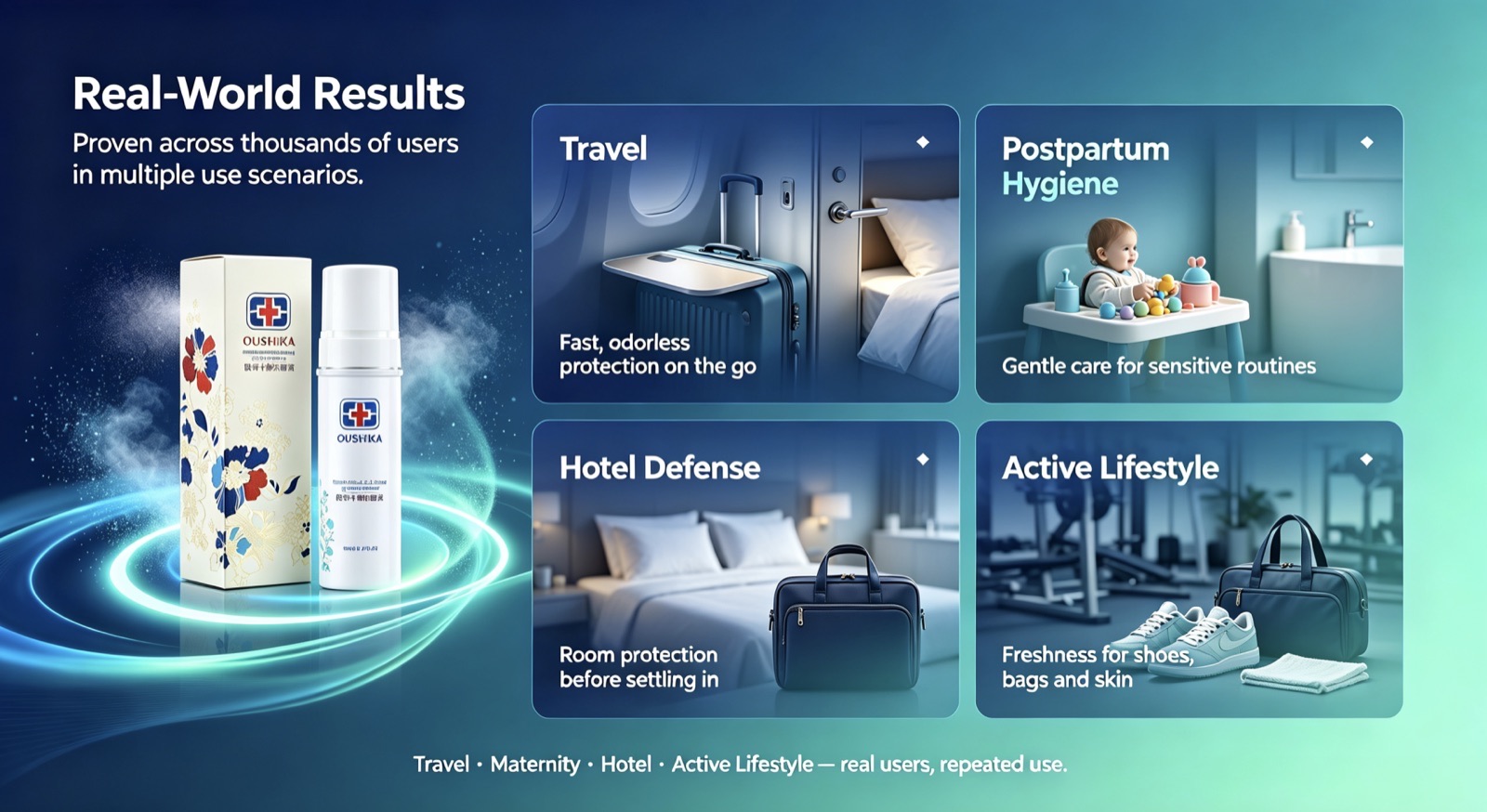
Liquid wash is no longer the default. Perineal spray is gaining ground because it answers the real-world use case: hands-free application, no second contact, portability for a hospital bag or handbag, and an even, gentle distribution across sensitive tissue. Wash and foam remain important for different user preferences, so format strategy — spray, wash or foam — directly changes packaging, filling equipment, MOQ and lead time in an OEM project. Lock the format to the end-user scenario before you brief the factory.
Trend 4: Audiences Expand Beyond Postpartum
Perineal hygiene now serves adults who simply want gentle daily care for sensitive external skin — easily irritated skin, on-the-go freshness, travel and gym-bag routines. A single well-designed base formula can support dual positioning: one line framed around postpartum recovery, another around everyday perineal comfort. The OEM decision then becomes whether minor formula tuning or mainly label differentiation serves both audiences — a scoping choice best made before development starts.
Trend 5: Regulatory Classification Is the Real Market-Entry Gate
A perineal care product does not sit in one tidy regulatory bucket. Depending on the claims and the jurisdiction it may be a cosmetic, a disinfectant/antibacterial product, or — if framed as treating a condition — step into medical territory. In the United States, cosmetic products and facilities follow MoCRA registration and claims must stay inside cosmetic boundaries. The European Union routes cosmetics through the CPNP notification portal. Southeast-Asian markets add their own layers: Singapore’s HSA and Indonesia’s BPOM each maintain classification and notification rules a brand must satisfy before listing. A capable contract manufacturer prepares documentation packages structured to support brand-side registration and notification in those markets, but it cannot guarantee approval — submission and claims remain the brand owner’s responsibility. Mis-classifying a product is expensive: blocked customs clearance, platform delisting or forced recalls are all downstream consequences of a category error made at the specification stage.
Formulation Essentials Behind a Credible Perineal-Care Product
Beneath the marketing language, a perineal-care product lives or dies on a short list of technical decisions:
- A cleansing system chosen for delicate tissue. Low-irritation systems designed for sensitive external skin, never a repurposed body-wash base with the pH forced down afterward.
- pH tuned to the surface the product actually contacts. External vulvar and perineal skin sits in a different band from internal tissue; the formula should be engineered for the surface it meets, and that fit should hold across batches and shelf life, not only on a lab-bench sample.
- Alcohol-free and fragrance-controlled. For postpartum and sensitive users, high alcohol loading and heavy synthetic fragrance are the most common sources of stinging and discomfort.
- Botanicals dosed for mildness, not for the ingredient deck. A botanical story only helps if the dose, extraction and preservative system are validated for delicate tissue.
- A preservative and stability strategy for wet formats. Spray, wash and foam are water-based; preservative efficacy, accelerated stability and long-term shelf-life data decide whether the batch the consumer receives still matches the batch that passed testing.
- Documented safety evidence. Heavy-metal and hazardous-substance screening plus recognized irritation and toxicology protocols, recorded by CMA-accredited independent institutions rather than asserted by the factory’s own laboratory.
The OEM Verification Checklist for Perineal Care Sourcing
When a buyer shortlists contract manufacturers for perineal care products, the six dimensions below separate a genuine quality system from a sales narrative. Ask for the documents, then read what was actually tested.
| Verification item | Key sourcing guidance |
|---|---|
| Quality-system credentials | Confirm SGS-certified ISO 22716 & GMPC documentation, and read the scope page of the production licences — cosmetic and, where relevant, disinfectant. |
| Third-party testing | Request CMA-accredited test reports covering safety, irritation and performance parameters — not internal self-tests. |
| Production environment | Confirm clean-workshop conditions for liquid filling of spray, wash and foam formats. |
| Dedicated intimate-care R&D | Check whether the factory develops formulas for delicate intimate tissue or merely re-labels a body-care base. |
| Commercial terms | Clarify liquid MOQ, sample turnaround and mass-production lead time for your target format. |
| Regulatory documentation | Confirm deliverables that support brand-side MoCRA, CPNP and Southeast-Asian notification, without over-promising approval. |

Why a Dedicated Intimate-Care Manufacturer Belongs in the Shortlist
Perineal care straddles two categories — cosmetic-grade gentle care and, for antibacterial claims, disinfectant-grade production. A general personal-care contractor typically holds one licence and one mindset. A manufacturer that built its business on intimate and postpartum care brings four things that matter specifically in this category:
- Dual-track production qualification. Separate, licensed lines for cosmetic products and disinfectant/antibacterial products mean a perineal line can include both a gentle daily wash and a disinfectant-registered antibacterial spray without switching factories — and without one category’s standards diluting the other.
- Formulation expertise tuned to delicate tissue. An intimate-care specialist develops bases for sensitive external and mucosal tissue from the start, instead of adapting a body-care formula and hoping it is gentle enough.
- Line breadth that lets one brand build a whole recovery range. If your postpartum roadmap needs a gentle wash, an antibacterial spray, a foam and a soothing serum, a partner that already formulates all four formats can shorten development, harmonize claims and simplify your supplier base to one.
- Retail validation through its own brands. A manufacturer that sells its own formulations through beauty-salon chains, postpartum-care centers and retail channels is iterating against real consumer feedback — what repeats, what stings, what women actually ask for at the counter — rather than against a laboratory’s assumptions.
One such manufacturer is Zhongkang Bainian, an OEM/ODM intimate-care factory in Quanzhou, China, with 37+ years of feminine and postpartum health heritage. It publishes the credentials a screening buyer should read before a sales call: SGS-certified ISO 22716 and GMPC quality systems, CMA-accredited third-party testing, a self-owned 20,000 m² facility with class-100,000 cleanrooms, and dual-track cosmetic and disinfectant production licences — (Min-Zhuang 20220008) for cosmetics and (Min) Wei-Xiao-Zheng-Zi (2021) No.040036 for disinfectants. Its alcohol-free perineal-suitable spray, gentle wash, foam and soothing formats cover exactly the range a postpartum or perineal-hygiene brand needs to launch as a line rather than a single product. See the certifications page for the certificates and the factory and R&D overview for the production floor.
How to Start: A Straightforward Path From Concept to Launch
- Fix the target market and the claims first. Choose the geography and the exact wording (hygiene, soothing, antibacterial) before any formulation work — the classification decision drives everything downstream.
- Choose the formula path. Start from a proven ODM stock formula (faster, lower risk) or brief a fully custom OEM formula for a proprietary point of difference.
- Lock samples and third-party testing. Request samples in roughly 7 working days, evaluate mildness and stability, and confirm the CMA-accredited test reports will cover the finished product.
- Confirm production and documentation. Liquid MOQ starts at 500 kg, mass production typically completes in 30–60 working days after approval, and the partner prepares documentation structured for your target markets’ registration or notification.
- Validate every claim against a report before launch. Making sure each statement on the pack is backed by evidence is the step that keeps a perineal-care line out of regulatory trouble later.
Key Takeaways
- Perineal care is an open sub-category where demand is rising across postpartum recovery, everyday hygiene and sensitive-skin care — and where the barrier to entry is technical, not just commercial.
- Position products as hygiene, comfort and freshness; framing them as treatment changes the regulatory category and the project risk.
- Alcohol-free, pH-conscious, botanical-led formulation is now the premium baseline for perineal products, and antibacterial claims belong in the laboratory report, not loosely on the pack.
- Format choice — spray, wash or foam — drives packaging, MOQ and lead time, so decide it against the end-user scenario before briefing the OEM.
- Regulatory classification differs by market (MoCRA, CPNP, HSA, BPOM); a manufacturer supports brand-side registration but never guarantees approval.
- Prefer a dedicated intimate-care manufacturer with dual-track licences, category-specific R&D and its own retail brands — the same evidence discipline applies whether you are buying a wash or a spray.
Sources
Standards and regulatory frameworks referenced in this article:
- ISO 22716:2007 - Cosmetics - Good Manufacturing Practices (GMP). International Organization for Standardization.
- US FDA - MoCRA (Modernization of Cosmetics Regulation Act) requirements for cosmetics facility registration and product claims.
- European Commission - CPNP (Cosmetic Products Notification Portal) registration for cosmetics placed on the EU market.
- Singapore Health Sciences Authority (HSA) - cosmetic and disinfectant product notification and classification requirements.
- Indonesia BPOM - cosmetic and health-product registration and notification requirements.
- Safety-testing references herein correspond to reports issued by CMA-accredited independent testing institutions.
Launch Your Perineal-Care Private-Label Line on Verified Standards
Tell us your target market and first format — we’ll show you the CMA test reports, production licences and alcohol-free formula options behind our perineal-suitable spray, wash and foam lines.
*This article is for informational purposes only. Market data and regulatory requirements vary by source and by market. Always consult with local regulatory experts before finalizing product specifications for your target markets.*